How Should Controllers Evolve?
 Date
Interview
Date
Interview
As the Edge Device market, including AI Devices, continues to expand rapidly, storage solutions are increasingly expected to deliver not only higher performance, data integrity, and power efficiency, but also to meet different requirements for each product and application.
These changes are setting new standards not only for the role of Controllers1, but also for how they are developed. To address these market changes, AIO, which develops NAND Flash Storage Controllers for Edge Devices, has developed its Tailorable Architecture2. We spoke with Seung-Hyun Han, CTO, who led NAND Flash Firmware design at Samsung Electronics’ Memory Business before co-founding AIO and has since led the development of Controller SoC Architecture and Firmware. He shared his insights on the evolution of Controller technology in the AI Devices era and the development philosophy behind AIO’s Tailorable Architecture.

A Changing Market Demands New Controllers
Over the past two decades, NAND Flash has continued to improve in storage capacity and performance through increases in the number of bits stored per cell (SLC → MLC → TLC → QLC) and the commercialization of 3D NAND. However, as integration density has increased, so has cell-to-cell interference, along with the likelihood of data errors, making Controller1 technology increasingly important for ensuring reliable operation.
The applications of NAND Flash-based storage have also expanded rapidly. While PCs and mobile devices were once the primary applications, NAND Flash-based storage is now used across a wide range of products centered on AI Devices, including smart devices, autonomous vehicles, and industrial robots. Even when based on the same NAND Flash technology, each product has different performance and operating requirements, while the Host Interfaces and customer requirements that must be supported are also becoming increasingly diverse. A key characteristic of the Edge market is that, unlike data centers or PCs, it does not have a standardized set of requirements; instead, requirements vary by product and application.
In this environment, it is difficult to keep pace with market changes by redesigning Controllers and Firmware from the ground up every time a new NAND Flash technology, Host Interface, or customer requirement emerges. This approach lengthens development cycles, increases validation costs, and makes it difficult to continuously leverage accumulated technologies and development experience in subsequent product development.
Seung-Hyun Han, CTO, explains that these changes call for innovation in how NAND Storage products are developed.
“In the past, competitiveness was about how well you could develop a single product. Today, it is about how quickly you can respond to a changing market. Controllers and Firmware must be flexible enough to adapt to evolving NAND Flash, diverse Host environments, and customer requirements.”
This is also the background behind AIO’s development of Tailorable Architecture2. To respond rapidly to market changes while ensuring proven quality and development efficiency, AIO recognized the need for a common architecture that could apply proven technologies across a wide range of products and enable their continued evolution, rather than redesigning Controllers and Firmware for each individual product. Through years of developing Controllers and Firmware to meet different product- and application-specific requirements in the Edge market, AIO has continuously built expertise in this field.
1 Controller: A core storage system semiconductor that reads and writes data between the Host and NAND Flash, corrects errors, and manages storage space.
2 Tailorable Architecture: AIO’s proprietary Controller platform developed to enable flexible Controller design and optimization for diverse NAND Flash and Host environments.

What Makes a Good Controller?
A good Controller must understand the characteristics of NAND Flash and deliver optimal performance and data integrity across diverse Host environments and customer requirements. These are key factors that determine the competitiveness of a Controller.
After studying RTOS1 and Embedded Linux2 at Seoul National University, Seung-Hyun Han, CTO, worked on NAND Flash Controller and Firmware development at Samsung Electronics’ Memory Business, where he gained first-hand experience of how Controller technology can determine product competitiveness. This experience led to the recognition that a Controller is not simply an interface chip, but a core technology that determines the performance and data integrity of NAND Flash-based storage. It also shaped his development philosophy that responding to evolving NAND Flash and diverse Host environments requires not the development of a new Controller for each product, but a systematic approach that ensures both development efficiency and quality based on proven technologies.
This philosophy continued after he co-founded AIO in 2011. AIO has established an integrated development system covering the entire product development process—from gathering customer requirements and Controller SoC design and development to Firmware design and development, Validation3, Qualification4, and mass-production support—with a focus on bringing technologies developed at the R&D stage into actual mass-produced products. This development philosophy now serves as the foundation for all Controller development at AIO.
1 RTOS (Real-Time Operating System): An operating system designed to process data and control devices in real time.
2 Embedded Linux: A Linux-based operating system optimized for use in embedded devices.
3 Validation: A development-stage verification process that confirms whether a product operates as intended by its design.
4 Qualification: A testing and evaluation process that verifies whether a semiconductor product meets a customer’s quality and performance requirements.

Tailorable Architecture: Controller Technology Designed for Change
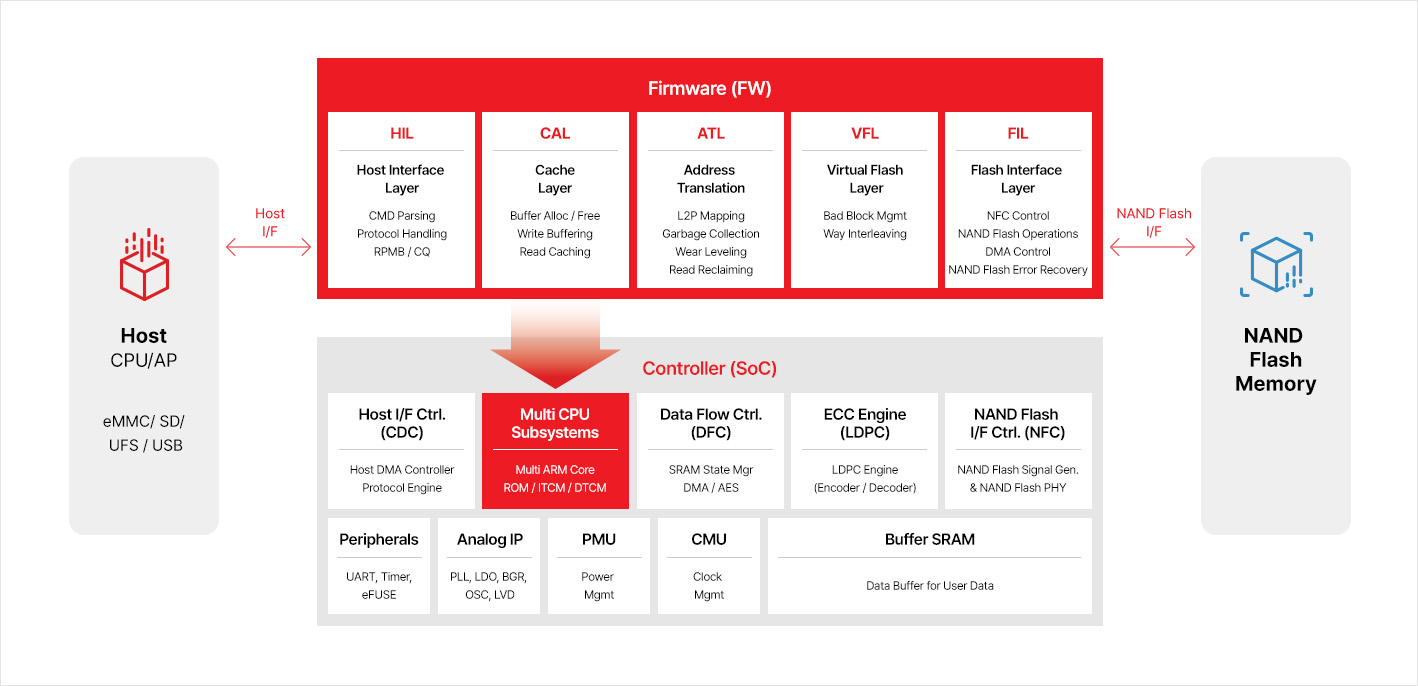
AIO’s Tailorable Architecture (NF-TSA) is AIO’s proprietary Controller architecture designed to flexibly optimize Controllers for diverse NAND Flash, Host Interfaces, and customer requirements based on proven Controller SoC and Firmware IP. By optimizing the functions required for each product and application environment using the same technology assets, AIO can efficiently respond to diverse product development needs and evolving market requirements.
At the core of Tailorable Architecture is the ability to extend proven technology assets across a wide range of products. Rather than applying a single Controller identically to every product, Tailorable Architecture optimizes the functions required for specific product characteristics and application environments based on the same Controller SoC and Firmware assets, enabling flexible support for diverse NAND Flash and application environments. It is designed to balance key technology goals—High Performance, High Reliability, and Low Power—with market requirements such as Low Cost, Backward Compatibility, and Customizability.
Validation results, Qualification experience, and mass-production know-how accumulated throughout the development process are also continuously leveraged in subsequent product development. Even when new NAND Flash or Host Interfaces are introduced, AIO can optimize the required functions based on proven technologies, improving development efficiency while enabling stable product development and consistent mass-production quality.
Tailorable Architecture is currently applied to the development of SD Card, UFD, and eMMC Controllers, through which AIO has accumulated mass-production experience and technology assets across a wide range of products. Building on these accumulated technologies, AIO continues to expand its application to industrial and automotive products, as well as to products using other interfaces such as UFS and cSSD.
While SD Card, UFD, and eMMC are classified as Legacy standards from a Host Interface perspective, they remain among the most widely used storage solutions across numerous Edge Devices worldwide. The NAND Flash used in these products, however, transitions to new generations on a relatively short cycle of 1 to 1.5 years. AIO therefore continues to develop Controllers that support the latest NAND Flash even for products using Legacy Host Interfaces. In this sense, the Edge storage market is a Long Tail market in which diverse products coexist over extended periods, making continuous technology development essential even when the Host Interface itself is considered Legacy.
Seung-Hyun Han, CTO, explains that the core of Tailorable Architecture is a Controller platform that can flexibly respond to diverse product and market requirements based on proven technologies.
“A good Controller should not be a technology designed for just one product. It must be able to continuously adapt to new NAND Flash technologies and diverse application environments that emerge over time. Tailorable Architecture is AIO’s core Controller technology, built to respond flexibly to these changes. Just because a Host Interface is considered Legacy does not mean the technology stops evolving. As long as NAND Flash continues to evolve, the Controller technology that supports it must evolve as well.”
In the era of Edge Devices, including AI Devices, storage performance requirements and application environments will become increasingly diverse. Based on Tailorable Architecture, AIO will continue to advance its Controller technologies to flexibly respond to evolving NAND Flash and diverse application environments, further strengthening its storage platform competitiveness for next-generation AI Devices.
1 Tailorable Architecture (NF-TSA): AIO’s proprietary Controller platform developed to enable flexible Controller design and optimization for diverse NAND Flash and Host environments.